


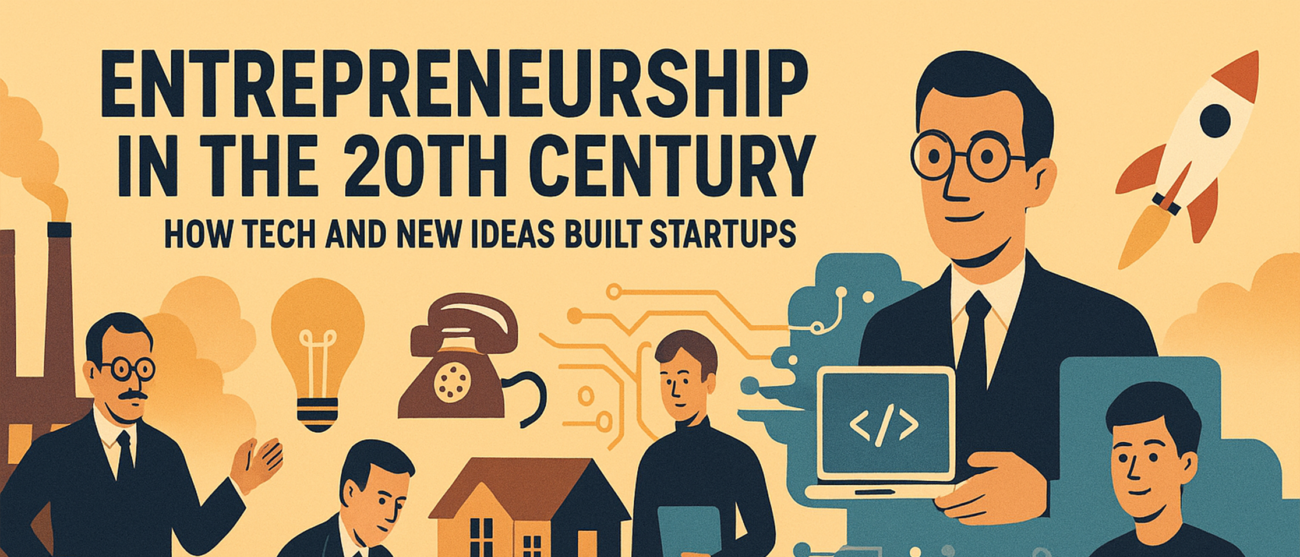
Entrepreneurship in the Industrial Revolution: The Birth of Modern Business
Before the Industrial Revolution, almost everything you owned was handcrafted, usually by a single artisan or in a small workshop. Imagine a baker kneading dough for each loaf or a weaver working on a single loom to produce a bolt of fabric. That was the world—slow, small-scale, and very personal. Then, starting in the late 1700s, everything changed. Machines came to life, steam power replaced human and animal effort, and a new figure emerged: the entrepreneur. This wasn’t just a technological shift; it marked the beginning of modern business.
In earlier times, commerce was local and limited; a tailor might sew one shirt at a time, and a blacksmith might make one horseshoe. The Industrial Revolution flipped the entire system upside down. Suddenly, someone with a bold idea and enough determination could achieve something huge. These new entrepreneurs weren’t always the inventors of the machines—like the steam engine or the spinning jenny—but they were the ones who recognized the broader potential. They asked, “What if I could put a hundred of these machines in one building? What if I could produce thousands of shirts instead of just a few?”
That question led to the creation of the factory, the core of this new economy. For the first time, it became possible to bring together workers and machines under one roof to produce goods on a large scale. However, this work was not easy. Factories were costly. Entrepreneurs needed land, buildings, expensive machinery, and raw materials. This required money, or capital. Entrepreneurs either had to be wealthy themselves or convince bankers and investors to support their vision. This marked the beginning of modern investment.
The factory system transformed everything. An individual tailor might sew a shirt in a day, but a factory, with machines and workers assigned to specific tasks, could produce hundreds. This “mass production” reduced costs, making goods affordable for ordinary people, not just the wealthy. Items like clothing, once a luxury, had gained the status of common essentials. Running a factory wasn’t a one-person job. Entrepreneurs hired managers to oversee workers, ensure quality, adhere to schedules, and coordinate the flow of goods. This led to the emergence of a new “white-collar” class—people who didn’t produce goods but organized production.
The era produced larger-than-life figures, known as “captains of industry” (though some earned the label “robber barons” for their ruthless methods). Take Richard Arkwright. He didn’t invent the spinning machine, but he improved it and built the first true cotton-spinning factory. He was the ultimate organizer, transforming a single invention into a system that revolutionized the textile industry.
There were people like Matthew Boulton and James Watt. Watt, a brilliant engineer, perfected the steam engine, but it was Boulton, the shrewd businessman, who saw its potential. He provided the money, the factory, and the drive to turn Watt’s invention into a global game-changer. Later, giants like Andrew Carnegie and John D. Rockefeller moved even further. Carnegie gained dominance in the steel industry, while Rockefeller controlled the oil refining. They showed how entrepreneurs could scale their businesses to a national level, reshaping entire industries.
This new world had a dark side, too. Early factories were often bleak places—dark, dangerous, and exhausting. Workers earned little, and child labor was widespread. The relentless pursuit of profit sometimes came at a heavy human cost, which eventually led to the formation of labor unions and government regulations to protect workers.
However, the Industrial Revolution unleashed something unstoppable. The entrepreneurs of that era laid the groundwork for the modern world. They proved that with innovation, investment, and organization, one person could transform how we produce and consume. Every time you buy a cheap t-shirt, drive a car, or tap on your smartphone, you’re living in the world they built—a world where dreamers with big plans could change everything.



Fantastic
Yo, everyone’s talking about casibom832. Decided to give it a shot. Alright, it’s got some cool features. Still exploring, but initial impressions are good. Worth checking out for the bonuses alone.