

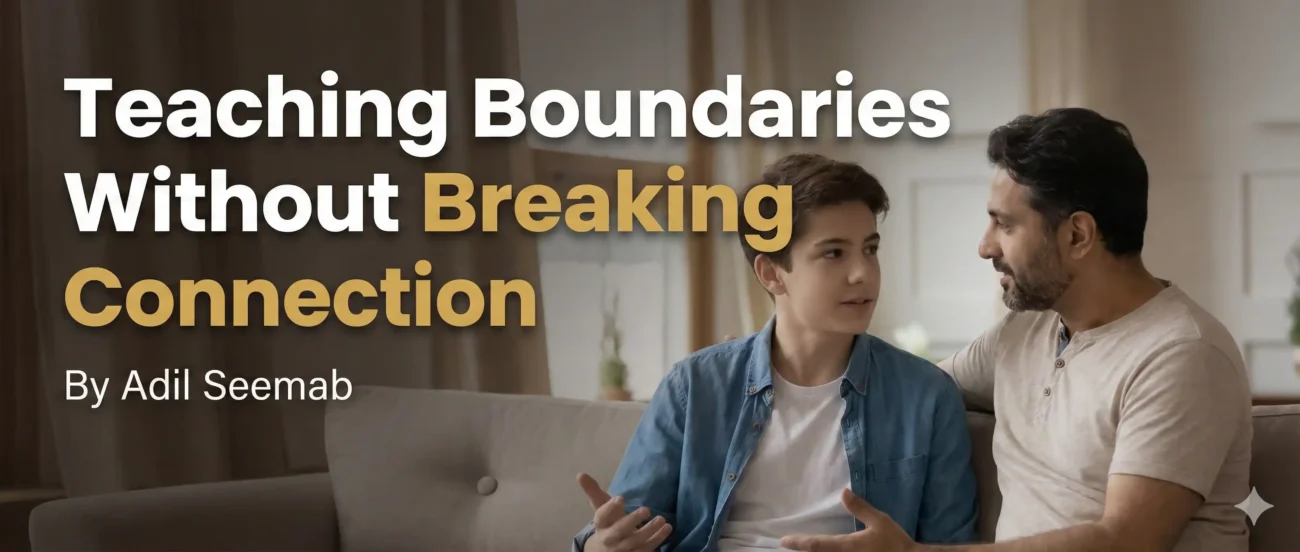
Teaching Boundaries Without Breaking Connection
By *Adil Seemab*
Children test limits the way they test gravity.
By leaning.
By pushing.
By falling a little.
I learned this slowly with Mansoor and Bazaid.
When they were younger, “no” felt like rejection to them.
When they became teenagers, “no” felt like control.
And for a long time, it felt like conflict to me.
But boundaries are not walls.
They are doors with frames.
One evening, they wanted to stay out late.
Plans were vague.
Voices were confident.
I said no.
The room tightened.
Arguments followed.
Logic came fast from their side.
I almost gave in.
Not because I agreed—but because I wanted peace.
Then I stopped.
I said, “I trust you. But I’m responsible for you. Tonight, this is my line.”
No shouting.
No lecture.
Just a steady voice.
They didn’t like it.
But they didn’t feel humiliated either.
That night taught me something important.
Children don’t need parents who say yes to everything.
They need parents whose no is calm, clear, and caring.
Boundaries give children something solid to lean on.
Without them, they feel lost.
With them, they feel held.
The mistake we often make is confusing firmness with harshness.
Firmness is quiet.
Harshness is loud.
When we shame, we break connection.
When we explain and stay present, we protect it.
A boundary spoken with respect teaches self-respect.
A boundary enforced with anger teaches fear.
There were times I crossed the line myself.
I raised my voice.
I withdrew affection.
Later, I returned.
I apologized.
I repaired.
That mattered more than being right.
Children watch how we hold limits.
They learn how to hold their own.
One day, they will say no to friends.
To pressure.
To harm.
They will borrow the tone we used.
Parenting is not about winning arguments.
It is about raising humans who can stand upright without hardening their hearts.
Strong boundaries.
Soft hearts.
That is the balance worth practicing every day.






Nustargameonline has got that old-school vibe, but with modern features. The game variety is solid. See for yourself: nustargameonline
QQ666casino is a strong choice. The website works well and has a good range of games to pick, I was able to find a new favourite!. Dive in: qq666casino
Jbo88mn is what i have been looking for. Solid choice of games and reliable payouts. Give it a shot you won’t be dissapointed: jbo88mn