

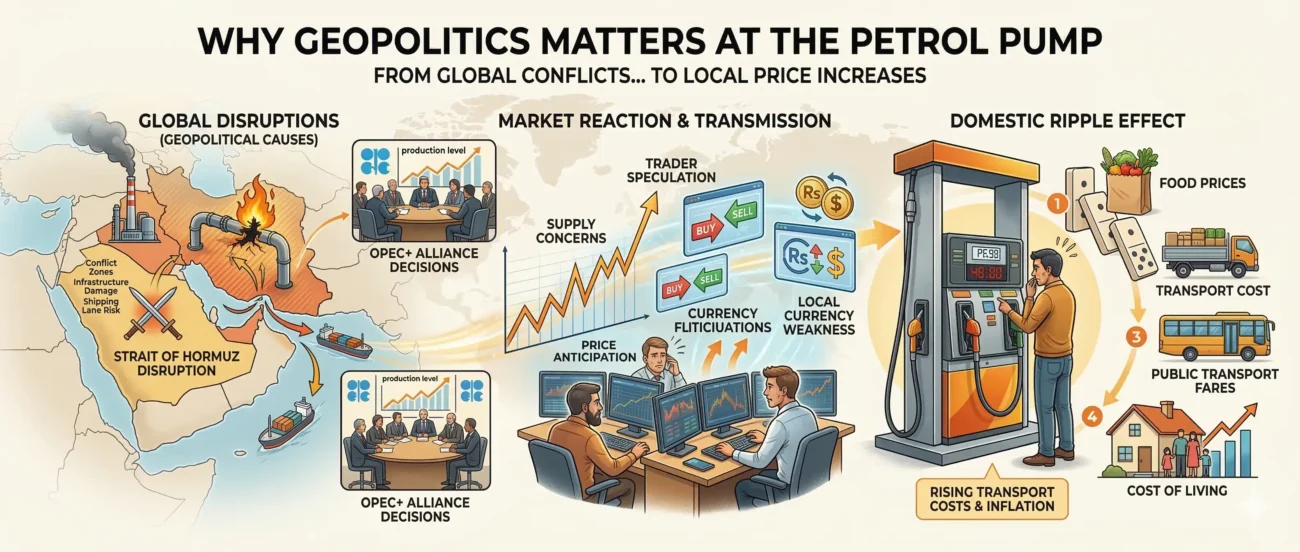
Why Geopolitics Matters at the Petrol Pump
Every time petrol prices rise, people blame the government or local oil companies. However, the price paid at the petrol pump is sometimes shaped by events happening far beyond national borders. The recent tensions in the Middle East, especially after the confrontation involving the United States, Israel, and Iran, illustrate how global politics can influence the cost of fuel around the world.
Wars, political tensions, and strategic decisions by powerful countries can disrupt energy markets. This relationship between international politics and energy prices is known as geopolitics. Understanding this connection helps explain why petrol prices sometimes rise suddenly, even when nothing significant seems to have changed in a country.
Oil: The Lifeblood of the Global Economy
Oil remains one of the most important resources in the modern world. It fuels cars, trucks, aeroplanes, ships, and industrial machinery. Like Pakistan, many countries also use oil and gas for electricity generation and manufacturing.
Because energy is essential for almost every sector of the economy, changes in oil prices quickly influence the cost of everyday goods. When oil becomes more expensive, transportation costs rise. This increase eventually affects the prices of food, clothing, and other basic products. In this way, fluctuations in oil prices directly influence the cost of living.
Why the Middle East Crisis Influences Oil Prices
A significant portion of the world’s oil supply comes from the Middle East. Because oil production is concentrated in this region, any political or military crisis there quickly affects global energy markets.
The recent escalation involving Iran, following the United States-Israel attacks, has created uncertainty in global oil markets. Even if oil production itself is not immediately disrupted, the fear that supplies could be affected has caused oil prices to react quickly.
Oil traders and governments closely monitor developments in the region. If they believe that conflict might interrupt oil production, exports, or transportation, they begin buying oil in anticipation of shortages. This reaction alone pushes prices upward even before any actual supply disruption occurs.
The Role of Oil-Producing Alliances
Global oil supply is also influenced by decisions made by major oil-producing alliances such as OPEC and the broader OPEC+ group.
These countries sometimes adjust their production levels in response to global political and economic developments. During periods of geopolitical tension, producers choose to limit supply to stabilize or increase prices. At other times, they increase production to calm markets and prevent extreme price spikes.
Because oil production decisions are often linked to political relationships and strategic interests, geopolitics plays a major role in shaping the global energy market.
Wars and Conflicts
Military conflict in or near oil-producing regions significantly affects the global energy supply. The current tensions surrounding Iran have raised concerns about the safety of oil in the region.
Pipelines, refineries, and export terminals have become targets or suffered disruptions during military escalation. Even if such damage has not occurred, the risk itself disrupts oil markets.
In addition, geopolitical conflicts often lead to sanctions and trade restrictions. If sanctions prohibit Iran from exporting oil, the global supply will tighten. When supply decreases while global demand remains strong, oil prices tend to rise.
For ordinary consumers, this means that a conflict taking place thousands of kilometers away quickly translates into higher petrol prices at local fuel stations.
Shipping Routes and Strategic Locations
Tankers carry oil from producing regions to major consumer markets through important maritime routes. One of the most critical of these routes is the Strait of Hormuz. A large share of the world’s oil shipments passes through this narrow waterway. Any conflict involving Iran raises concerns, and shipping through this route is disrupted.
When tensions threaten these sea lanes, shipping companies face higher security risks and insurance costs. In extreme cases, vessels delay or reroute shipments to avoid danger. These disruptions increase transportation costs and reduce the flow of oil to global markets.
When oil becomes harder or riskier to transport, international prices rise—and those increases eventually reach consumers. The same has happened in the wake of the Middle Eastern crisis.
Currency and Economic Power
Another factor influencing petrol prices is the global role of the US dollar. Oil is traded internationally in dollars, which means that exchange rates affect the cost of importing oil.
If a country’s currency weakens against the dollar, it must spend more of its own currency to purchase the same amount of oil. As a result, domestic petrol prices rise even if global oil prices remain stable. Pakistani consumers have suffered whenever the government devalued the currency.
In times of geopolitical crisis, financial markets also react strongly. Currency fluctuations, therefore, amplify the impact of rising oil prices on national economies.
Why Petrol Prices Change So Quickly
Oil markets react rapidly to global news and political developments. A single military incident changes expectations about future supply.
Because traders anticipate possible disruptions, prices move quickly in response to geopolitical tensions. The effects of these market reactions eventually appear at petrol stations, sometimes within days or weeks.
What This Means for Ordinary Citizens
For ordinary people, rising petrol prices have wide-ranging consequences. Transportation becomes costly, raising the prices of goods and services. Farmers have to spend more on fuel for machinery, while businesses face higher shipping costs.
Public transport fares also increase. Over time, these changes contribute to a higher cost of living for many households. In this way, geopolitical tensions—such as the current crisis involving Iran, the United States, and Israel—indirectly affect daily life far beyond the region where the conflict occurs.
The Future of Energy and Geopolitics
Many countries are investing in renewable energy sources such as solar and wind power to reduce dependence on fossil fuels. If these transitions succeed, the influence of geopolitical conflicts on energy prices will gradually decline.
However, the global economy is dependent on oil, and this dependence will continue for many years. As long as oil remains central to global energy systems, political tensions in key producing regions will continue to shape fuel prices.
The current Middle Eastern crisis has shown how closely global politics and energy markets are connected. The next time petrol prices rise, the reasons will not lie solely in domestic policies. The real causes will be rooted in international politics, conflicts, and global economic dynamics.
In today’s interconnected world, geopolitics does not remain confined to diplomatic negotiations or distant battlefields—it eventually reaches everyday life, right down to the petrol pump.




Leave a comment