

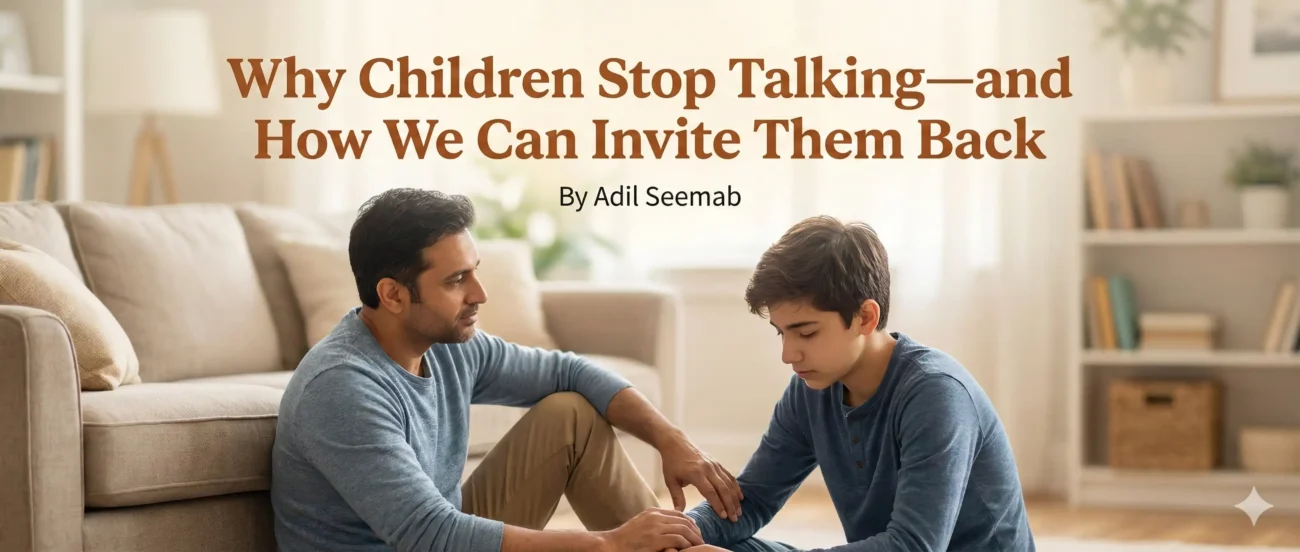
Why Children Stop Talking—and How We Can Invite Them Back
By Adil Seemab
Children talk freely at first.
About clouds.
About fears.
About nothing important.
Then, slowly, they don’t.
I noticed it with Mansoor and Bazaid.
The stories grew shorter.
The answers cleaner.
“Yes.”
“Fine.”
“Nothing.”
At first, I thought it was age.
Teenage silence.
Normal distance.
But silence has a memory.
It remembers how it was treated.
Children stop talking when words feel unsafe.
When questions turn into cross-examinations.
When feelings are corrected.
When mistakes are met with lectures.
They learn fast.
They learn that speaking costs energy.
They learn that quiet is cheaper.
I saw it one evening.
I asked how their day went.
Before the answer came, I added advice.
Then concern.
Then a warning.
They listened politely.
Said little.
Left early.
That night, I understood something painful.
I had not been listening to hear.
I had been listening to respond.
Children don’t open up to intelligence.
They open up to presence.
The next time, I tried differently.
I asked one question.
Then I stopped.
There was silence.
Longer than comfort allows.
Then Bazaid spoke.
Slowly.
Uncertainly.
I didn’t interrupt.
I didn’t fix.
I didn’t judge.
I just stayed.
And something softened.
Listening is not passive.
It takes restraint.
It takes humility.
When we rush to teach, children retreat.
When we stay curious, they lean in.
They don’t need us to solve every feeling.
They need us to respect it.
Sometimes the most powerful sentence is,
“Tell me more.”
And sometimes the strongest support is silence that doesn’t leave.
Children talk when they trust the space.
They return when they believe they won’t be corrected into silence.
Connection is rebuilt the same way it was first formed.
One safe moment at a time.
If we want our children to talk when life gets hard,
we must listen when life feels ordinary.
That is where trust learns to stay.




Jilifishslot is my go-to when I’m lookin’ for a quick slots fix. The fish games are super addictive, and they’re a great way to unwind after a long day. Give it a try, you might find yourself hooked! Check out jilifishslot and catch some wins.
Pesomaxlogin, my friend! Simple, straightforward, and gets the job done. Had a smooth experience logging in and getting started. That’s all I ask for. Thumbs up! Explore pesomaxlogin!
Yo, I just downloaded the Megapari APK from their site and it was smooth sailing. Honestly, the app runs great on my phone. Worth checking out if you’re into mobile betting eh? megapariapk