

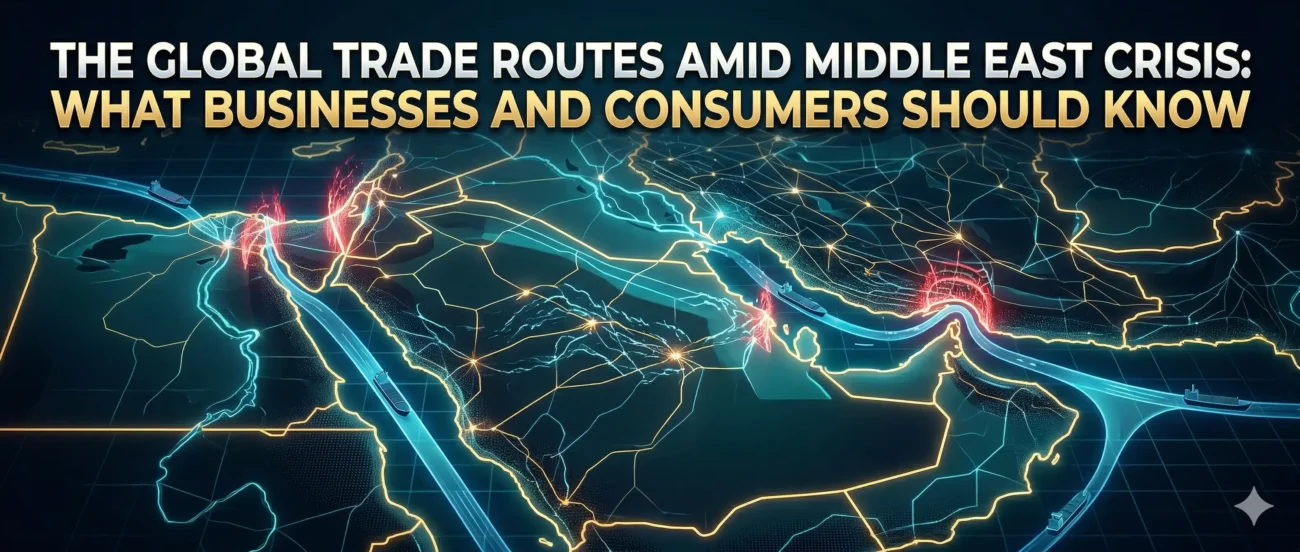
The Global Trade Routes Amid Middle East Crisis: What Businesses and Consumers Should Know
In today’s interconnected world, global trade depends heavily on a few key routes. When tensions rise in important regions, especially the Middle East, the effects extend beyond politics — quietly impacting homes, markets, and businesses everywhere. Recent escalation involving the US-Israel invasion of Iran, and Iran’s missile and drone strikes on Saudi Arabia, Kuwait, the United Arab Emirates, Bahrain, and Qatar, has once again shown how vulnerable these trade routes are.
This blog explains what is happening, why it matters, and how it could impact everyday life.
What’s Happening and Why it Matters for Trade?
To understand the problem, imagine a major highway suddenly being blocked. All the trucks that use that road have to find a new route—but the detour is long, narrow, and costly. The US-Israel invasion of Iran has created an environment that is unfavorable for oil and gas trade with the rest of the world. Iran has disrupted the movement of oil tankers in the region.
The Middle East is more than just a region; it acts as an essential global trade hub. Several of the world’s most important shipping lanes pass through it. One such lane is the Red Sea, connected to the Mediterranean via the Suez Canal. Another crucial route is the Strait of Hormuz, where a large share of the world’s oil is moved. Even a small disruption to these routes can have effects felt all around the world.
The war has disrupted the flow of oil and gas through the Strait of Hormuz. About 20% of the world’s oil and gas trade passes through this route. The resulting supply shortage has already led to an energy crisis. If this disruption persists, it could trigger a global energy crisis with serious impacts on businesses and consumers.
What Will Happen If Tensions Persist?
If the conflict escalates in the region, several consequences will follow. Shipping routes will become riskier and more disrupted. Cargo ships will avoid dangerous areas due to fears of attacks or blockades. Insurance costs for shipping companies will increase sharply.
Delays in the supply chain and the adoption of longer, new routes will happen. New shipping methods to the Mediterranean will be created to move oil and gas out of the region, requiring a lot of time and resources. This will cause longer delivery times and higher fuel costs.
Since 20% of oil shipments go through the Strait of Hormuz, any disruption to this route has caused a crisis. This has impacted fuel, electricity, and even food prices.
Impact on Businesses and Consumers
For businesses, especially in developing countries, the consequences are severe. Raw materials and finished goods become more expensive due to higher shipping and fuel costs. Shipment delays can halt production, particularly in industries that depend on imported components. The Philippines has started experiencing a severe energy crisis. Its government has declared a one-year emergency, and in some other countries, there are long lines at gas stations. Businesses are facing planning challenges because of uncertain delivery times and fluctuating prices.
For the average person, the effects may seem indirect; however, they are very real. Initially, fuel prices increase, leading to higher transportation costs, which then raise the prices of everyday goods. Imported products may soon face shortages or delays. Household budgets will tighten as essential items become more expensive.
What Should be Done?
Businesses should take practical steps to reduce risk by diversifying suppliers to avoid dependence on the affected region, maintaining buffer stock to handle delays, closely monitoring global developments, and investing in local production when possible.
While individuals cannot control global events, they should prepare themselves to manage household budgets responsibly, avoid unnecessary spending during uncertain times, stay informed about price trends, and plan purchases wisely, especially for essential goods.
Final Thoughts
Global trade may seem distant, but its effects hit close to home. A conflict thousands of miles away impacts the cost of fuel, food, and daily essentials.
The ongoing tensions in the Middle East serve as a reminder that the world’s economic system is fragile and interconnected. For businesses and consumers alike, awareness and preparation are the best tools for navigating uncertain times. In a fast-changing world, those who adapt early will experience fewer shocks later.






Hey, tayawinlogin is where its at, quick login and easy gameplay, really fun. Thumbs up from me, you wanna play tayawinlogin.
[6881]aq99 লগইন ও অ্যাপ ডাউনলোড | বিকাশ দিয়ে অনলাইন স্লট গেম,aq99 লগইন করে সেরা অনলাইন স্লট গেম খেলুন। বিকাশ দিয়ে অনলাইন ক্যাসিনো ডিপোজিট এবং অ্যাপ ডাউনলোড করে সহজেই গেম শুরু করুন। আজই জয়েন করুন। visit: aq99