

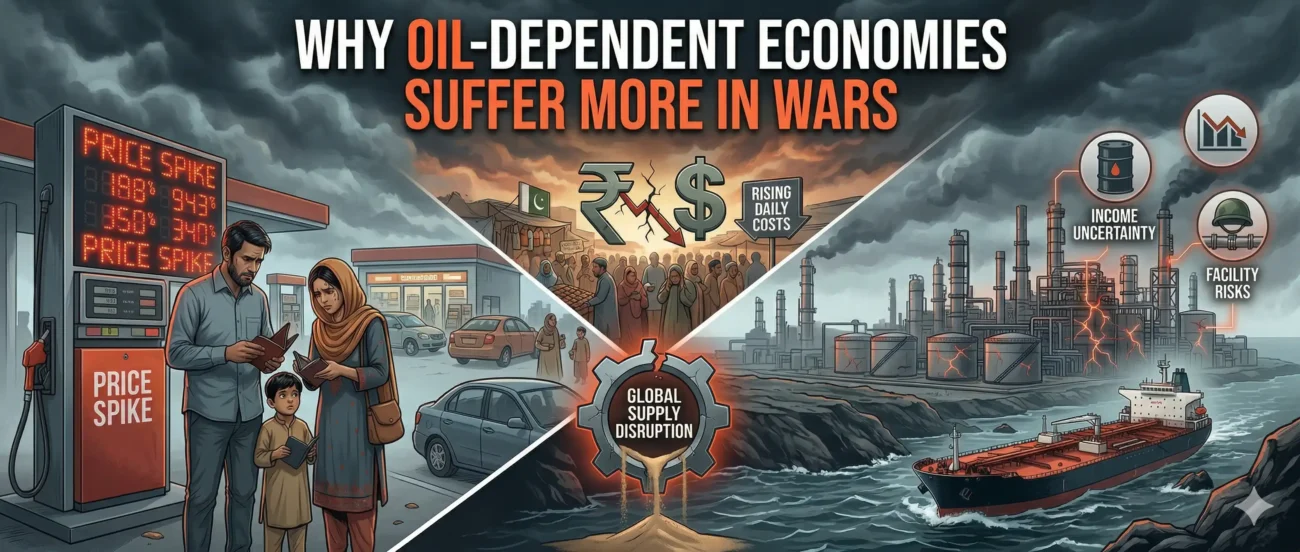
Why Oil-Dependent Economies Suffer More in Wars
Wars do not stay limited to battlefields—they spread into everyday life. The ongoing tensions in the Gulf region, especially involving Iran, Israel, and the direct involvement of the United States, have once again shaken global oil markets.
For ordinary people, this shows up as simply rising prices, expensive fuel, and economic uncertainty. But the impact is not the same for all. Oil-dependent economies—both importers and exporters—are feeling the pressure the most.
What Is an Oil-Dependent Economy?
An oil-dependent economy is one where a significant portion of the country’s income, trade, or energy needs comes from oil. There are two main types:
- Oil-exporting countries like Saudi Arabia and Iraq generate most of their income by selling oil.
- Oil-importing countries like Pakistan, China, and India rely on buying oil from others to run their economies.
Right now, both groups are facing serious challenges because of the Gulf crisis—but in different ways.
Why the Current Gulf Crisis Is Disrupting Oil Markets
The Gulf region is the heart of the global oil supply. Any conflict here quickly affects the whole world. In the current situation:
- There are fears of disruption near the Strait of Hormuz, a key route through which a large portion of the world’s oil passes
- Rising military tensions have created uncertainty about future oil supply
- Countries are reacting with caution, building reserves, and adjusting trade
Even if the oil supply has not completely stopped, fear and uncertainty alone push prices upward.
Impact on Oil-Importing Countries
Countries like Pakistan, India, and China are already under economic pressure, and the current crisis is making things worse.
- Rising Fuel Prices: As global oil prices increase, petrol and diesel become more expensive locally. This directly affects transport and daily commuting.
- Expensive Daily Life: Higher fuel prices lead to:
- Increased food prices (due to higher transport costs)
- Expensive electricity (especially in countries relying on oil-based power)
- Rising prices of basic goods
For an average household, this means less purchasing power.
- Pressure on Government Finances: Governments often try to protect people by offering subsidies. But during prolonged crises:
- Subsidies become too expensive
- Budget deficits increase
- Loans and debt rise
- Weakening Currency: Countries need more dollars to import costly oil. This weakens local currencies like the Pakistani rupee, making all imports even more expensive.
Impact on Oil-Exporting Countries
Countries that rely heavily on oil (called “petrostates”) put most of their eggs in one basket. Oil can make up 50-90% of their exports and government money. When war hits:
- Income Uncertainty: Oil prices are highly unstable during crises. They may rise sharply—but can fall just as quickly if tensions ease. This makes economic planning difficult.
- Security Risks: In the current Gulf tensions:
- Oil facilities and pipelines are at risk
- Shipping routes may be targeted
- Insurance and transport costs increase
- Even the fear of attacks affects exports.
- Sanctions and Political Pressure: Countries like Iran face sanctions, which limit their ability to sell oil freely. This reduces their income despite high global prices.
- Overdependence Problem: Many oil-exporting countries rely too heavily on oil revenues. When a crisis hits, the economy becomes vulnerable. Due to overdependence on oil and gas, other sectors (like industry and tourism) remain weak and cannot support the economy in a crisis.
In short, oil brings quick wealth but makes economies fragile—like a house built on sand. Diversified countries (with strong manufacturing, technology, or services) bounce back more easily.
Why the Strait of Hormuz Matters So Much
Though the involvement of Houthis from Yemen has also endangered the other route, the key concern at the moment is the Strait of Hormuz.
- Nearly a fifth of the world’s oil passes through this narrow route
- Any blockage or threat can disrupt global supply
- Even rumors of closure can push prices higher
This is why global markets react immediately to tensions in this area.
Global Impact of the Current Crisis
The effects are not limited to the Middle East. Around the world:
- Inflation is rising
- Economic growth is slowing
- Stock markets are becoming unstable
- Air travel and shipping costs are increasing
Even countries far from the conflict are feeling the pressure.
Why Oil Dependence Makes Things Worse
Oil-dependent economies suffer more because:
- They rely on a single critical resource
- They lack strong alternative energy sources
- Their economies are not well diversified
In simple terms, they have fewer options when a crisis hits.
What Can Countries Do?
The current Gulf crisis is a reminder that countries need long-term solutions:
- Importers should invest in renewable energy (solar, wind).Major oil-importing nations have already started investing heavily in renewable energy to reduce import bills. Key nations include Turkey, Pakistan, India, China, Spain, and Portugal.
- Exporters are to diversify the economy (technology, agriculture, industry). Saudi Arabia and the UAE are trying to diversify into tourism, finance, and technology, but progress is slow, and wars set them back.
Countries that take these steps are better prepared for future shocks.
Final Thoughts
The ongoing Gulf tensions involving Iran, Israel, and global powers like the United States show how quickly oil markets can become unstable.
For oil-dependent economies, the impact is deeper and more painful—whether they are buying oil or selling it.
The lesson is clear: relying too much on oil makes an economy fragile. In an uncertain world, diversification and energy independence are no longer choices—they are necessities.






The app version is a game changer. I can play anywhere and the graphics are top notch. Just downloaded pa777app and I am already hooked.
[5998]igobet login ও অ্যাপ ডাউনলোড | বিকাশ দিয়ে অনলাইন ক্যাসিনো,igobet login করে সেরা স্লট গেম সাইটের অভিজ্ঞতা নিন। বিকাশ দিয়ে অনলাইন ক্যাসিনো পেমেন্ট এবং লাইভ ক্যাসিনো খেলার নিয়ম জানতে আজই অ্যাপ ডাউনলোড করুন। visit: igobet
[9660]hay baje লগইন এবং অ্যাপ ডাউনলোড | বিকাশ ক্যাসিনো গেম,hay baje লগইন করে উপভোগ করুন সেরা অনলাইন স্লট গেম ট্রিকস এবং লাইভ ক্যাসিনো বোনাস অফার। বিকাশ দিয়ে ক্যাসিনো গেম খেলতে আজই অ্যাপ ডাউনলোড করুন। visit: hay baje