

You Are Doing Your Best—Now Let’s Understand What Your Child Needs Next
By Adil Seemab
I know you are doing your best to give the best to your children.
You wake up with their worries.
You sleep with their future on your mind.
You provide.
You protect.
You guide.
And yet, there are moments when it feels like it is not enough.
Your child resists.
Delays work.
Gets lost in screens.
Shuts down when you try to help.
You wonder, What am I missing?
The Problem Beneath the Problem
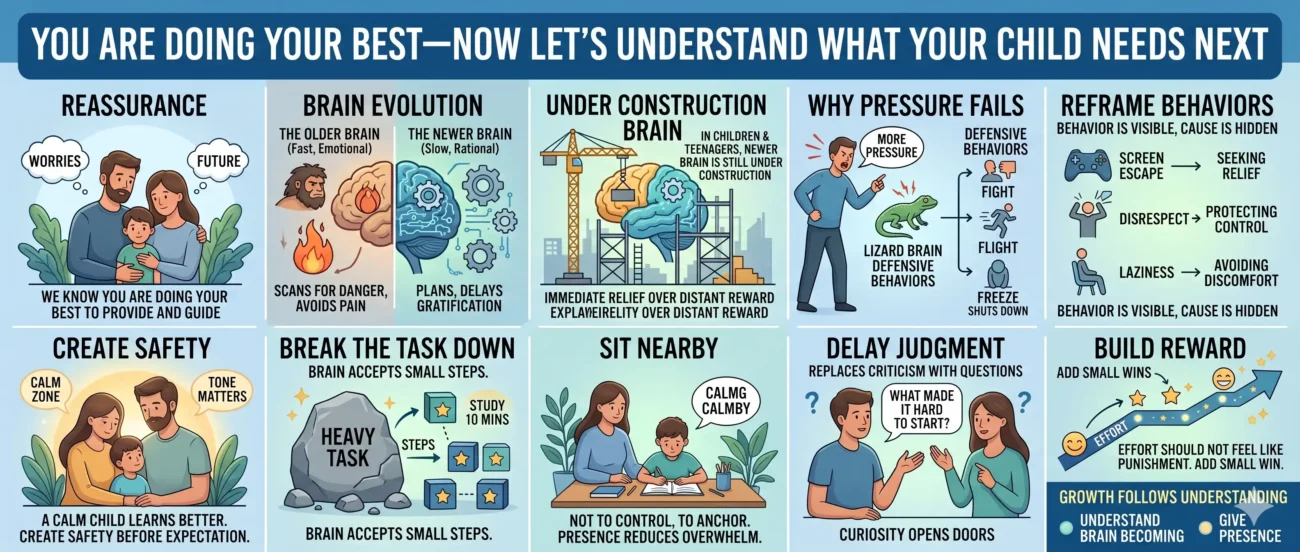
What we often call “laziness” or “disobedience” is rarely that simple.
A child who avoids work is not always avoiding effort.
He may be avoiding discomfort.
A child who argues is not always disrespectful.
He may be protecting his sense of control.
A child who escapes into screens is not always addicted.
He may be seeking relief.
The behavior is visible.
The cause is hidden.
What Evolution Taught the Brain
The human brain did not evolve for exams, schedules, or long-term planning.
It evolved for survival.
Deep inside, there is an older brain.
Fast. Emotional. Alert.
It scans for danger.
It seeks comfort.
It avoids pain.
Then there is the newer brain.
Slow. Rational. Thoughtful.
It plans.
It delays gratification.
It makes decisions for the future.
In children and teenagers, this newer brain is still under construction.
So when a child delays work,
it is often the older brain choosing immediate relief over distant reward.
When he reacts emotionally,
it is the older brain speaking faster than the rational one can respond.
This is not failure.
It is development.
Why Pressure Backfires
When we push harder,
the older brain senses threat.
It moves into defense.
Fight.
Flight.
Freeze.
The child argues.
Avoids.
Or shuts down.
What looks like defiance
is often protection.
What Actually Helps
The goal is not to overpower the older brain.
The goal is to support the growth of the newer one.
1. Create Safety Before Expectation
A calm child learns better than a stressed one.
Tone matters more than words.
2. Break the Task Down
The brain resists large effort.
It accepts small steps.
“Study for two hours” feels heavy.
“Start with ten minutes” feels possible.
3. Sit Nearby
Not to control.
To anchor.
Presence reduces overwhelm.
4. Delay Judgment
Instead of “Why didn’t you do it?”
Ask, “What made it hard to start?”
Curiosity opens doors.
Judgment closes them.
5. Build Reward in the Process
The brain seeks reward.
Add small wins.
A break.
A walk.
A shared laugh.
Effort should not feel like punishment.
A Quiet Realization
One evening, I saw Mansoor sitting with his books, not moving.
I almost said, “Why are you wasting time?”
Instead, I asked, “Where are you stuck?”
He pointed to one question.
That was it.
Not laziness.
Just one barrier.
We solved it together.
He moved forward.
Sometimes the problem is not the child.
It is the weight of the task.
*
You are not failing as a parent.
You are parenting a brain that is still becoming.
Be patient with the process.
Stay steady in your presence.
Children do not need more pressure.
They need better understanding.
And when understanding enters the home,
growth follows quietly.






A must-read blog for those who aspire to see their kids happy and growing.
Login is fast and the games start instantly. No lagging or crashes which is exactly what I need when gaming. 168jililogin makes everything so effortless.
Downloading the app was the best decision. It is much faster than the browser version and the lag is gone. Get the 389winappapk