

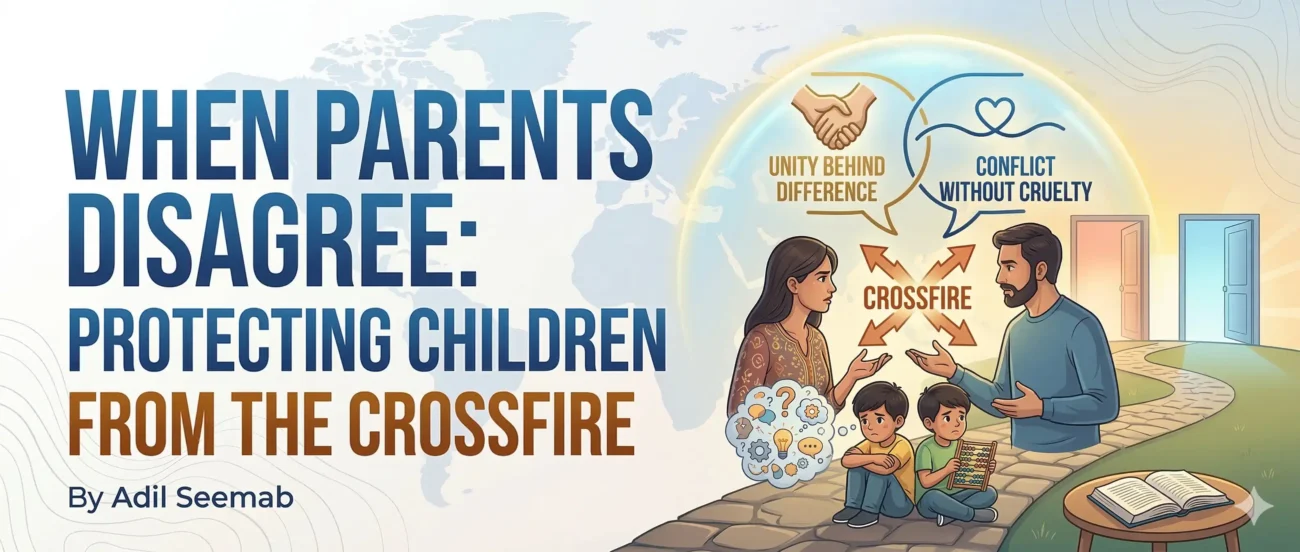
When Parents Disagree: Protecting Children from the Crossfire
By Adil Seemab
Children notice tension before they understand it.
A pause in conversation.
A sharp tone.
A door closed harder than usual.
Homes do not break in loud moments.
They crack in repeated ones.
I saw this once in our own home.
Mansoor and Bazaid were younger then.
Their mother and I disagreed about something small.
Homework.
Timing.
A routine.
The discussion grew louder than it needed to be.
The boys said nothing.
But they became quiet.
Children watch their parents the way sailors watch the sky.
They look for signs of a storm.
Disagreement between parents is normal.
Two minds cannot always move in the same direction.
The real question is not whether parents disagree.
The real question is how they disagree.
If arguments turn into insults, children feel unsafe.
If voices rise without respect, children learn that power wins over reason.
But when disagreement stays calm, children learn something rare.
They learn that conflict can exist without cruelty.
Later that evening, their mother and I spoke again.
Quieter this time.
We explained our positions.
We listened.
We adjusted.
The boys were nearby.
They watched without speaking.
What they saw was more important than the decision itself.
They saw two adults disagree—and remain allies.
Children need to see unity behind difference.
Parents can say, “We think differently about this.”
And still say, “But we stand together.”
That sentence protects a child’s sense of stability.
Another lesson matters too.
Never pull children into adult sides.
When a child hears, “Tell your father he is wrong,”
or “Your mother doesn’t understand,”
the child becomes a battlefield.
No child should carry that burden.
They should never feel responsible for keeping peace between adults.
Peace is our responsibility.
And sometimes the strongest act of parenting is repair.
An apology between parents teaches humility.
A calm conversation teaches respect.
Children learn how relationships survive conflict.
One day, Mansoor and Bazaid will disagree with people they love.
Friends.
Partners.
Colleagues.
What they witnessed at home will guide them then.
If they saw shouting, they will shout.
If they saw dignity, they will remember dignity.
Parenting is not only about raising children.
It is also about showing them
how adults treat each other when things are not easy.


Leave a comment